Written on Friday, December 08, 2006 by Gemini
A chainsaw-wielding killer and blood-splattered shooting rampages are featured in some of the 10 video games that a media watchdog group says should be avoided by kids and teens.
The US’ National Institute on Media and the Family released its 11th annual video game report card Wednesday. The group urged parents to take a stronger role in safeguarding their children from games that glamorise sex and violence.
“Video games will never die,” said Douglas Lowenstein, president of Entertainment Software Association. “Finger-pointing and demonising a form of entertainment that is embraced by the millennial generation is fruitless. Partnering with parents to help them help their kids pays off.”
The institute showed video clips of graphic scenes of sex and violence from several newly released video games. A scene from Scarface: The World is Yours showed a man attacking victims with a chainsaw as blood splatters across the screen. A man clubbed several victims in a bloody scene from Dead Rising. Characters spew obscenities in Saints Row.
Institute president David Walsh said that educating parents on how to use the controls and to spend time with their children to learn about the games they are playing is vital. He suggested limiting game time for kids and asked parents to keep them away from M-rated games.
“We have to put our kids on a media diet,” he said.
GAMES TO AVOID
- Gangs of London
- The Sopranos
- GTA: Vice City Stories
- Reservoir Dogs
- Mortal Kombat: Unchained
- Scarface: The World is Yours
- The Godfather: Mob Wars
- Saints Row
- Dead Rising
- Just Cause

Written on Thursday, December 07, 2006 by Gemini
‘Forgetful People At 10% Higher Risk’
Being forgetful is bad for your heart. Those who have poor memories and slower reaction times are more likely to die from a heart attack, according to a 21-year study. Psychologist Beverly Shipley, who carried out the research, said the next step was to discover exactly why there was a link. She suggested that one possible explanation was that reaction time is an indicator of a body with better “system integrity”— how well it is wired together. She said one surprising outcome of the study was that both young and old adults showed the same link between cognition and heart trouble.
Even in the case of young people, memory problems could be used to identify those not normally thought to be at risk of heart disease. Shipley, member of Edinburgh University’s psychology department, studied more than 6,400 individuals. She found those who had slower reaction times, poorer memory and poor visual-spatial awareness had a higher chance of dying from cardiovascular or respiratory disease.
The link remained even after taking into account other factors usually associated with heart disease, like physical activity, blood pressure, obesity and smoking. Participants were aged between 18 and 99 and were first tested in 1984/85. The study was completed in 2005. Researchers found lower than average level of mental agility led to at least a 10% greater chance of heart disease. They also found a higher death rate from heart problems among those with poor mental agility.
Written on Thursday, December 07, 2006 by Gemini
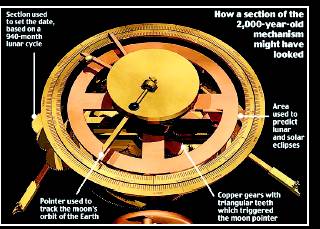
Using high-tech to peer beneath the surface of the 2,100-year-old machine, scientists have discovered gears that work the world’s oldest astronomy computer

(Picture) Using high-tech to peer beneath the surface of the 2,100-year-old Antikythera Mechanism, scientists say the device could predict the ballet of the Sun and Moon over decades and calculate a lunar anomaly that would bedevil Isaac Newton himself
An international team of astronomers, mathematicians, computer experts, script analysts and conservation experts has unravelled the secrets of a 2,000-year-old computer which could transform the way we think about the ancient world.
Professor Mike Edmunds and Dr Tony Freeth, of Cardiff University led an international team of scientists who believe they have finally cracked the workings of the Antikythera Mechanism, a clock-like astronomical calculator dating from the second century BC.
Remnants of a broken wooden and bronze case containing more than 30 gears and cogs was found by divers exploring a shipwreck off the island of Antikythera at the turn of the 20th century. Scientists have been trying to reconstruct it ever since. The new research suggests it is more sophisticated than anyone previously thought.
Detailed work on the gears in the mechanism show that it was able to track astronomical movements with remarkable precision. The calculator was able to follow the movements of the moon and the sun through the Zodiac, predict eclipses and even recreate the irregular orbit of the moon. The team believe it may also have predicted the positions of some or all of the planets.
The findings, revealed in the journal Nature, suggest that Greek technology was far more advanced than previously thought. No other civilisation is known to have created anything as complicated for another thousand years. “This device is just extraordinary, the only thing of its kind,” said Professor Edmunds. “The design is beautiful, the astronomy is exactly right. The way the mechanics are designed just makes your jaw drop. Whoever has done this has done it extremely well.”
The device contained ‘calendar’ dials, inscribed with the names of the months and the signs of the zodiac. Winding these dials to a future date lined up other dials capable of predicting the position of the moon, the phase of the moon and whether there would be an eclipse. The team was made up of researchers from UK-based Cardiff University, the Greek National Archaeological Museum of Athens and the Universities of Athens and Thessaloniki.
They were aided by UK-based X-Tek, who developed powerful X-Ray computer technology to help them study the corroded fragments of the machine, while computer giant Hewlett-Packard provided imaging technology to enhance the surface details of the machine. The mechanism is in over 80 pieces and stored in precisely controlled conditions in Athens where it cannot be touched. Recreating its workings was a difficult, painstaking process.
The researchers are now hoping to create a computer model of how the machine worked, and, in time, a full working replica. It is still uncertain what the ancient Greeks used the mechanism for, or how widespread this technology was. “It does raise the question what else were they making at the time,” said Edmunds. “In terms of historic and scarcity value, I have to regard this mechanism as being more valuable than the Mona Lisa.”
Still in fragments, the mechanism, plus a reconstruction, are on display in Greece at the National Archeological Museum of Athens.
Written on Tuesday, December 05, 2006 by Gemini
Car manufacturers contemplate living, breathing, clean, green, killer machines
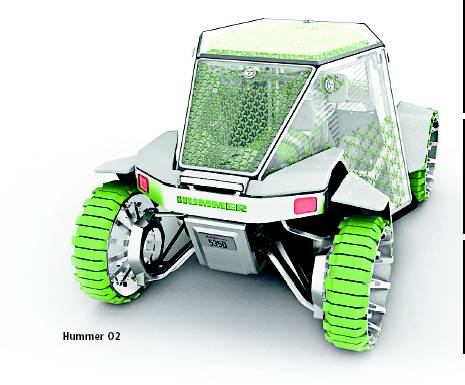
In the imagination of car manufacturer, General Motors, the fuel-guzzling, Hummer could be transformed from the SUV that environmentalists love to hate to an algae-infused, oxygen-exuding buggy that opens up like a flower. GM’s sketch for the “Hummer O2” was named the winner on Thursday of a design contest at the Los Angeles Auto Show that challenged major automakers to design a vehicle with a five-year life span that could be fully recycled.
OTHER ENTRIES IN THIS YEAR’S DESIGN CHALLENGE WERE:
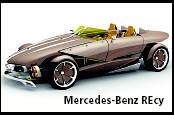
1. Mercedes-Benz REcy:
The REcy, designed by Mercedes-Benz Advanced Design of North America, is a car that is 100 per cent recyclable.It would be made of wood,alloys, glass and rubber and powered by a fourcylinder bio-diesel engine.
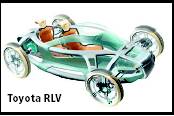
2. Toyota RLV:
CALTY Design Research suggested a light-weight electric-powered, tandem-style vehicle where the driver can switch between an electric-driven and a human-driven mode (by pedalling).The car’s manual mode is meant to be used in the stop-and-go-traffic.
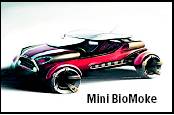
3. Mini BioMoke:
BMW’s DesignworksUSA conceptualised a car, which would be composed of biodegradable body panels infused with palm tree seeds. So when the vehicle’s lifespan is up, the buried body panels spring into trees, which help clean the air of toxins.
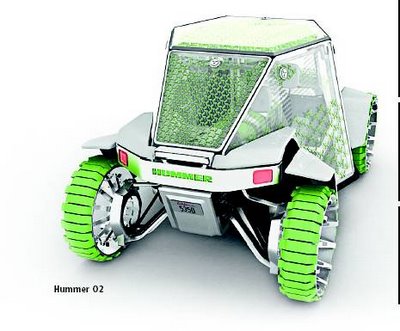
4. GM Hummer O2
The GM vision for the Hummer O2 includes an algae-filled body shell, designed to shed oxygen. It also opens up like leaves on a stem to catch sunlight when parked. The concept sketch, which was produced by GM’s Advanced Design Studio, shows the Hummer riding on an aluminium shell and powered by a hydrogen tank and fuel cells.
“This design team said, ‘We’ve done hybrids. We’re doing fuel cells. What’s the next step that actually improves the environment?’” said Frank Saucedo, director of GM’s design lab.
Saucedo said the GM team had deliberately chosen the Hummer for its imagined environmental remake... “People think of it as a military vehicle and a SUV, but really these types of vehicles were for people who worked in the outdoors, environmentalists, naturalists and outdoorsmen,” he said. “This is just us coming full circle.” The GM entry in the Los Angeles Auto Show Design Challenge won out over a number of equally ambitious vehicle sketches from other automakers.
5. Acura FCX 2020 Le Mans:
The Acura FCX 2020 racing car, from the Acura Design Centre, would be powered, the designers say, “by a compact fuel cell made possible by molecular nanotechnology.”
6. Audi Dynamic Space Frame:
Volkswagen/ Audi Design Centre’s entry would have a single fluid-electrical component that integrates the chassis, transmission and electronic controls. It would swap a traditional driveshaft for a fluid-filled body charged with an electric current.
7. Honda Extreme:
The Extreme concept designed by Honda R&D features a honeycomb polycarbonate chassis that can be combined with different body styles to achieve complete customisation.
8. Kia Sandstorm:
Hyundai Kia America Design Centre’s entry is a biodiesel hybrid plug-in with body panels that can be switched and recycled whenever its owner desires a new look.
9. Volkswagen Nanospyder:
The Volkswagen/Audi Design Centre, meanwhile, offered a vehicle capable of being constructed by nanomachines smaller than a half a millimetre. The point? These microscopic builders could vary the density of the vehicle’s frame, enabling more responsive crumple zones for enhanced safety.
Written on Sunday, December 03, 2006 by Gemini
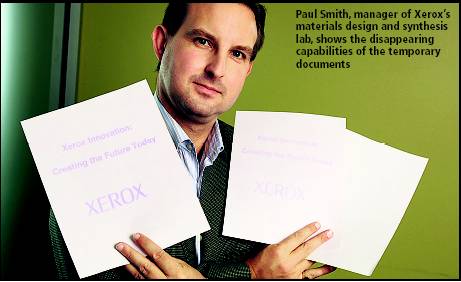
Scientists at Xerox have invented a way to make paper whose images last only a day, so that it can be used again and again.
The technology that blurs the line between paper documents and digital displays could someday replace printed pages that are used for just a brief time before being discarded. Xerox estimates that as many as two out of every five pages printed in the office are for what it calls “daily” use, like e-mails and reference materials that have been printed for a single viewing.
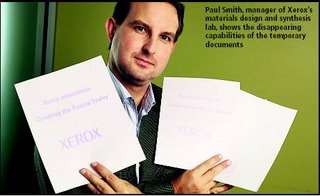
“Despite our reliance on computers to share information, there is still a strong dependence on the printed page,” said Paul Smith, manager of Xerox’s materials design and synthesis lab. “Self-erasing documents or ‘erasable paper’ for short-term use offers the best of both worlds.”
To develop erasable paper, researchers needed to identify ways to create temporary images. The “Eureka” moment came from developing compounds that change colour when they absorb a certain wavelength of light, but then will gradually disappear. In its present version, the paper self-erases in about 16-24 hours and can be used multiple times.
While scientists at Xerox work on the chemistry of the technology, researchers at US-based PARC (Palo Alto Research Centre), a subsidiary of Xerox – with whom they are collaborating on the project – are investigating ways to build a device that could print onto the paper.
PARC researchers developed a prototype ‘printer’ that creates the image on the paper using a light bar that provides a specific wavelength of light as a writing source. The written image fades naturally over time or can be immediately erased by exposing it to heat.
While potential users have shown interest, there is still much to be done. “This will remain a research project for some time,” said Eric Shrader, PARC area manager, industrial inkjet systems. “Our experiments prove that it’s possible, and that is the first step to developing a system that is commercially viable.”