Written on Friday, July 18, 2008 by Gemini
Those who have watched The Jetsons cartoon show might remember Rosie, the robotic kitchen maid. Now, scientists are working towards making her a reality
In a new project, German scientists are providing a glimpse into the kitchen of the future; complete with a new robot that can keep track of the contents of the larder, and learn simple tasks. Their automaton, they say, could soon be making your dinner while you relax! According to the researchers at the Technical University of Munich, who are involved in the ‘Assistive Kitchen’ project, the B21 robot exploits the use of radio-frequency identification (RFID) tags on dishes and utensils to avoid some of the object-recognition difficulties that have plagued previous household robots.
“If you want to interpret and understand everyday activities using vision data, it’s very complicated, error-prone, and resource intensive. But if you do the same with RFID tags, there is very little sensor information, but it’s highly correlated with the activities you are performing,” lead researcher Michael Beetz said.
The researchers say that not only does their robot know where everything is, but it can also learn simple tasks simply by observing the movements of the objects. Setting the table is very easily recognised from cups and plates disappearing from the cupboard and appearing on the table – and cleaning up later is characterised by the same objects disappearing from the table and appearing in the dishwasher. Robots would even search Web sites and use language software that convert natural language into robot-friendly instructions.
Posted in
Communication research,
Robotics
|

Written on Saturday, June 28, 2008 by Gemini
US scientists say they have written new software that enables the blind to surf the Internet at any place.
Richard Ladner, a professor of computer science at the University of Washington (UW), revealed that the software – dubbed WebAnywhere – can read aloud Web text on any computer with speakers or headphones. “This is for situations where someone who’s blind can’t use their own computer, but still wants access to the Internet: At a cyber caf, a school, at a friend’s house, etc,” said Ladner. Doctoral student Jeffrey Bigham developed WebAnywhere under Ladner’s supervision. Unlike current screen-reading software, WebAnywhere is the first accessibility tool to be hosted on the Web – meaning it doesn’t have to be downloaded onto a computer.It processes the text on an external server located in UW, and then sends the audio file to play in the user’s Web browser.“You don’t have to install new software.
So even if you go to a heavily locked-down computer, say at a library, you can still use it,” Bigham said.While testing, the researchers asked a few visually impaired people to use it to do three things – check email, look up a bus time table and search for a restaurant’s phone number. People using WebAnywhere – which, so far, works only in English – were able to successfully complete all three tasks, using a variety of machines and Internet connections. The free program and audio-visual demonstrations are available online at http://webanywhere.cs.washington.edu/.
Posted in
Communication research,
Gadgets,
General research,
Interesting
|
Written on Thursday, May 29, 2008 by Gemini
In recent times, the world's leading technology universities are opting in for a different business model, for the sole need of survival. Earlier they were involved only in research & development, and were least focused on the business front. The things started changing when investors in these institutions reduced their investments and hence these R&D centers started looking concentrating on business as well. That's why you'll see many R&D institutes going out in the market selling their research. Many leading technology institutes are in this league. However, in my opinion, Yissum - the technology transfer services company of the Hebrew University of Jerusalem - is in the lead position through its highly appreciated university technology transfer programs. It is responsible for marketing the inventions and know-how generated by the University's renowned researchers and students. It has expertise in diverse domain from nanotechnology to medicine and pharmaceuticals, agriculture and nutrition, water and environmental technologies to computer science to homeland security. Speaking in terms of numbers, Yissum has granted 400+ technology licenses and is responsible for commercializing products of over $1 billion in worldwide sales every year. Over the past 40 years, Yissum has churned out many popular products like Exelon, Doxil, Superior ceramic ink, UV pearls, Sumo - louse repellent, and Ram onion. There are many successful companies that are born at Yissum including Algen Biopharmaceuticals, Avian Tech, Ester Neurosciences, HumanEyes Technologies, and many more. Yissum has won many patents (and many more are pending) on various technologies namely Single Image Dehazing, Prevention of Age-Related Retinal Deterioration, New Biosensor for Nerve Gases, Drought-Tolerant Trees, and Process for Producing Organic Ultra Thin Films. I am mesmerized by the wide array of their research in technology field - Improved Cache Performance with Reduced Energy Consumption; Compiler Aided Ticket Scheduling; Markov Model Application for DNA-Arrays and Gene Identification just to name a few. If you want to involve yourself in the world's leading technology institution and contribute to the award winning technologies / products, I recommend Yissum - a true technology transfer company.
Posted in
Communication research,
Dangerous research,
Energy research,
General research,
Health research,
Interesting,
Life Saving Research,
Nanotechnology
|
Written on Friday, April 25, 2008 by Gemini
At home your family’s waiting… At work, your boss is frowning as usual… But you have not yet finished working on the file in your desktop.
This is a quite a familiar scenario with most of the working people. How often have we heard them wish, ‘if only we could complete this at home’… Accessing from home the files which are saved in your office computer was just a dream till now. However, it is now possible to access files saved in any computer from any other computer!!!
 GoToMyPC allows you to remotely access your computer (assuming it is connected to the Internet) from any other computer (connected to the Interner) in the world. This means that one can seamlessly access / send e-mails, work on projects, documents, or network resources, without physically present in that location! This site offers simple yet powerful software that has to be installed in both the computer you wish to access and the computer you would be accessing it from. The process of registration is quite simple and post-registration, you can choose from the personal, premium and corporate options. While the personal option allows you to access two remote computers, the premium enables access to five computers and you can access the whole office if you subscribe for the corporate plan.
The corporate account is a conscious effort by the company to help its employees access their office work from a remote computer. Don’t worry about the security! This software is quite secured and can be used with the existing firewall setup without disturbing its integrity. An access code resides on the host computer and is never saved onto the website’s servers, so no more leaks. You’d also get notified if someone is trying to break in. There is a built-in lockout protection where you can even disable the keyboard and screen in such cases. This is just like virtual private network (VPN) that has been in use in many companies. However GoToMyPC is the first third party VPN service that’s being used. It is a convenience tool that many software companies are using so their employees can look at their files from home.
Try GoToMyPC now!!!
Posted in
Communication research,
Gadgets,
New software,
Products
|
Written on Saturday, April 19, 2008 by Gemini
American Apparel makes RFID sexy...

Retailer American Apparel Inc., known for its risqué ads and "Made in Downtown LA" label, is putting radio frequency identification tags (RFID) on every Boy Beater tank, Baby Rib brief, Cross-Back bra and Sleeve Ringer T-Shirt in its 17 New York metropolitan area stores. That's 40,000 items per store, each tagged with a high-tech chip, starting with the Columbia University location in Manhattan. The company is using Vue Technology's TrueVue software to manage the RFID data, Motorola Inc. RFID readers and antennae to capture the data and Avery Dennison Corp. tags to locate and store that data at the item level. Los Angeles-based American Apparel is on an aggressive timetable to roll out the sophisticated inventory tracking system to an additional 120 stores in North America.
The question is why. RFID tagging on crates -- never mind individual pieces -- is currently on the radar for only a handful of retailers, mainly behemoths like Wal-Mart Stores Inc. and its legions of suppliers now under orders to adopt transponder tags or else.
RFID is tricky, said John Fontanella, an analyst at AMR Research Inc. in Boston. "The use cases for RFID are not as obvious as some proponents would have you believe," he said. Automating a process like taking inventory changes the way people work, and that "requires a significant amount of re-engineering," Fontanella said, and up-front labor. There's little doubt of that, said Zander Livingston, RFID technology director at American Apparel. The manual tagging for a single store alone required multiple employees working three full days. But for American Apparel, with its numerous, nearly identical styles in a rainbow of colors, the technology makes a lot of sense.
"The No. 1 reason is inventory accuracy," Livingston said.
American Apparel differs from a lot of other apparel companies, Livingston said, in that it displays one -- and one only -- of each size, style and color of a particular item on its sales floor. Each item in each of its color and size variations has a place on the salesroom floor, but the company does not load up the racks with multiples of the same kind. "So basically, as soon as an item has been taken off the rack to be tried on, or purchased or just carried around the store as the customer is browsing, the item is no longer available. We also have a lot of items that look similar to each other, and because of that a lot of items get misplaced," Livingston said. The high sales volume often means that more than 1,000 items a day are moving back and forth between stockrooms and salesrooms.
"We'd have 10% of the items lost in the stock room that needed to be on the sales floor. Part of my goal was to make sure that we had a perfectly fitted sales floor, at 100% capacity," said Livingston, an old classmate of American Apparel CEO Dov Charney from their prep school days at the elite Choate Rosemary Hall, who was recruited by Charney to put RFID to work. Accuracy was a big problem. Taking manual count of 10,000 items on the sales floor and the 30,000 stocked in the basement means having to ask employees to come early or stay late. Fatigued employees might glance at the tag in the collar, but because of the similarity in styles, misidentify the item. RFID accuracy is 100%.
Tom Racette, director of RFID market development for Mortorola's Enterprise Mobility Division, said RFID is becoming easier to implement. "A couple of years ago, this was all about the big challenging implementation, putting RFID across the supply chain. We are seeing more and more retailers, and businesses of all kinds, who are finding creative ways of implementing RFID in ways that are providing value," Racette said. Dr. Bill Hardgrave, professor of information systems and executive director of the Information Technology Research Institute at the University of Arkansas, said in a statement, "We've noticed an increasing trend among retailers that are implementing RFID at the item level, and American Apparel is a prime example of a retailer on the forefront of this trend."
By deploying the technology in additional stores, American Apparel expects to increase sales and customer service by having real-time visibility into products at nearby stores, enhancing the intrastore transfer process to balance stock, Racette said. Furthermore, the retailer will be able to respond more efficiently to market behavior by using RFID to record and report on purchases, not only within one location, but also across a region of stores.
For CIOs, they are looking at RFID and seeing that inventory accuracy is going from 80% to 99%, as it did in the American Apparel pilot, and that RFID is reducing the cost of managing inventory substantially, said Chris Schaeffer, director of RFID product marketing at Motorola. "CIOs are tasked with figuring out how to utilize the IT infrastucture to bring business value, and this can improve processes and efficiencies. It's good for a CIO to be able to say, 'See how this technology investment helped me do that,'" Schaeffer said.
Livingston did not give out a dollar figure for the investment, except to say the cost was about equivalent to the salaries of two full-time sales employees per store. The project is not without challenges, he cautioned. The deployment takes a "little more human interaction" than perhaps initially anticipated to verify everything being transported from the stockroom to the sales floor. He had to re-evaluate certain work movements so RFID readers were not blocked. It can be difficult to read tags around metal, for example. Down the road, he wants to design portals to capture theft -- people walking out the door with stuff -- but the "gates" have to be "aesthetically pleasing" so they are not in odds with American Apparel's meticulous stores. Livingston said the next step is to cut down on the manual labor by tagging items at the manufacturing plant. "I'm not going to tag another item in New York until there is source-level tagging."
Source: SearchCIO article
Posted in
Communication research,
Energy research,
Gadgets,
Interesting,
Nanotechnology,
RFID
|
Written on Tuesday, March 18, 2008 by Gemini
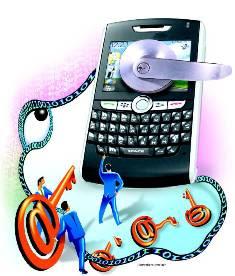
When Canadian company Research In Motion (RIM) launched BlackBerry in 1999, within no time the revolutionary mobile device that enabled users to browse the Net, read emails in real-time and send fax documents earned the nickname, CrackBerry, an allusion to its notoriously addictive features. Like all secure internet services, RIM uses an encryption code that scrambles the email messages sent out from a BlackBerry device and then unscrambles it again when the message reaches its target. Only, Blackberry uses a highly complex algorithm for the purpose — a 256-bit advanced encryption standard process. The Intelligence Bureau (IB) of The Government of India allegedly can decode messages with an encryption level of up to 40 bits. (According to cyber security experts, there’s a rigid decryption technology hierarchy in the world: The US has the most advanced software, Europe gets tech that’s one generation behind and countries like India have even older decoders.)
So, if intelligence agencies cannot crack BlackBerry’s email code, they can still do one of two things — get the government to force RIM to scale down its encryption code to 40 bits, or better still, ask for the “keys” that will unlock the code. The Section 69 of the IT Act, 2000 does give the government the power to intercept electronic information, but such sweeping surveillance is clearly stretching the law. And, what impact will it have on ecommerce? People will be extremely concerned about sending business details through the Net. For instance, the licensing norms for ISPs in India were created in 1998-99. Accordingly, licenses issued to ISPs forbid encryption above 40 bits. Today, a 40-bit code can be cracked in no time. A browser like Internet Explorer 7 has a 128-bit code. So, any web provider using an encryption of over 40 bits has to provide the keys to the government. This means that the government has the means to track transactions and correspondences in these websites — an access it doesn’t have in the BlackBerry platform since the ISPs providing these services were, for some reason, never asked to hand over the encoding key.
Terror organizations are constantly changing their footprint and upgrading their technology. Today if we have tracked say, 555 web-pages linked to the terror network, tomorrow they may all disappear and return modified. It’s a nightmarish scenario for security agencies. However, the powers of surveillance can be misused. That’s a devil you have to live with. Unfortunately, the legal and political framework needed to check misuse of cyber-snooping by our politicians is lacking in the country. That’s a point many cyber experts are making. Can the intelligence agencies ensure fairplay? People may be willing to give up some of their civil liberties for dealing with the security threat to the country. But there should be a clear-cut policy framework and laws on what kind of invasion is lawful and what’s not. Clearly, there’s room for legislative action and transparency in cyberspace.
SHORT CUT TO ENCRYPTION
What? – In IT, encryption is a software that uses advanced algorithms to scramble a message being sent out in cyberspace. The message is unscrambled when it reaches the recipient.
Why? – It’s a security measure to prevent internet data being read by unintended persons.
Who Uses It? – All web browsers, e-commerce, banking sites and email service providers use encryption software to ensure secure transactions and confidentiality.
Does It Change? – Yes, encryption technology is constantly evolving. A few years back, codes that were 40 bits long were considered safe. Now, 128-bit codes are default in most sites. BlackBerry uses a more advanced 256-bit algorithm.
Can It Be Cracked? – Software can be developed to crack encryption codes. Security agencies use these to monitor data flow in cyberspace. Obviously, longer codes are harder to crack.
What Is A Key? – This is the sequence of bits used by an encryption algorithm to scramble a message and put it back again. It unlocks the code.
Source: Sunday Times, March 16, 2008
Posted in
Communication research,
India,
Mobile,
Security
|
Written on Monday, February 11, 2008 by Gemini
Indian inventor creates sticky notes with RFID tags that can not only SMS you your reminders, but can also help you locate books and key-chains from around your home!!!
Imagine you scribbled a sticky note about an upcoming doctor’s appointment. You place the note on your home desktop computer, only to forget about the appointment. But guess what? The note reminds you about your appointment via a friendly text message on your mobile phone.
Indeed, such technology will soon be possible, thanks to Pranav Mistry, an alumnus of IIT-Bombay.
Sticky notes are one of the most ubiquitous and convenient items in our daily lives. By simply scribbling and sticking them on a surface, they help us manage our ‘to-do’ lists and capture short reminders or information that we may need in the near future. But with our lives going digital, pen and paper are fast losing their place of importance.
“I love sticky notes,” says Mistry, a graduate student at the US-based Massachusetts Institute of Technology’s Media Lab. “They are handy and quick. But I wanted them to be active, remind me of my appointments, and help me manage my world better; so I just made them a little smart.” Mistry, who hails from Palanpur in Gujarat, is the inventor of ‘Quickies’ – intelligent sticky notes that can be digitally searched, located, and can send reminders and messages.
The goal of Quickies is to bring one of the most useful inventions of the 20th century – the sticky note – into the digital age, says Mistry. Quickies connect remotely to a computer, collaborate seamlessly, and update you via various sources, such as sending an SMS on your mobile phone.
How does it work?
 The process is simple: As the user notes down a reminder on a physical sticky note, the information is simultaneously captured and stored as a digital note on a computer. A computer program, coupled with digital-pen hardware, enables this capturing. The computer program processes the digital note, recognises and converts the hand-written text into digital text, and applies some computational methods to understand the context and the content of the information.
The program is also smart. For example, in a scenario where a note was written about an appointment, it updates the user’s calendar and also reminds him of the scheduled appointment via an SMS on his mobile phone. The Quickies can also be used as location tags for items such as books. “One of the most interesting features is ‘findability’. At the back of each of the Quickies is a unique RFID tag, which makes it possible to locate them in the house or office,” Mistry says.
But wouldn’t the Quickies be rendered useless without the digital pen? Not so. “The core innovation that drives ‘Quickies’ lies in the algorithms and intelligence,” Mistry says. “Although there are many digital pens which can be used with the technology, a small scanner would eliminate their need, and a normal pen could be used in that setup. Just to let you know, we have a version where you don’t need to be near a computer.”
And what would the cost be?
“At present, the system costs us around $75 (Rs 3,000), although that can be cut by half,” he says.
Posted in
Communication research,
Gadgets,
RFID
|
Written on Wednesday, October 17, 2007 by Gemini
Following is an excellent message from none other than Bill Gates, on the topic of “Age of Software Powered Communications”!
If you've been in the work force for 20 years or more, you can remember a time when the pace of business-and life in general-was quite a bit slower than it is today. Back then we read newspapers and magazines and watched the network news to stay informed. Faxes were just becoming a common way to share written business information. A phone call might elicit a busy signal or no one would answer at all. In those days, no one expected to send documents to coworkers on the other side of the globe instantly, collaborate in real-time with colleagues in distant cities, or share photographs the very day they were taken.
These and similar advances have delivered remarkable results. The ability to access and share information instantly and communicate in ways that transcend the boundaries of time and distance has given rise to an era of unprecedented productivity and innovation that has created new economic opportunities for hundreds of millions of people around the world and paved the way for global economic growth that is unparalleled in human history.
But few people would argue that there is no room for improvement. Although we have once-unimaginable access to people and information, we struggle today to keep track of emails and phone calls across multiple inboxes, devices, and phone numbers; to remember a growing number of passwords; and to synchronize contacts, appointments, and data between desktop PCs and mobile devices. The fact is that the proliferation of communications options has become a burden that often makes it more difficult to reach people than it used to be, rather than easier.
In 2006, I wrote about how unified communications innovations were already beginning to transform the way we communicate at work. Because you are a subscriber to executive emails from Microsoft, I want to provide you with an update on the progress we're making toward achieving our vision for unified communications. I also want to share my thoughts on how rapid advances in hardware, networks, and the software that powers them are laying the foundation for groundbreaking innovations in communications technology. These innovations will revolutionize the way we share information and experiences with the people who are important to us at work and at home, and help make it possible to put the power of digital technology in the hands of billions of people around the globe who have yet to reap the benefits of the knowledge economy.
Moving Beyond Disconnected Communications
A fundamental reason that communicating is still so complex is the fact that the way we communicate is still bound by devices. In the office, we use a work phone with one number. Then we ask people to call us back on a mobile device using another number when we are on the go, or reach us on our home phone with yet another number. And we have different identities and passwords for our work and home email accounts, and for instant messaging.
This will change in the very near future. As more and more of our communications and entertainment is transmitted over the Internet thanks to email, instant messaging, video conferencing, and the emergence of Voice over Internet Protocol (VoIP), Internet Protocol Television (IPTV), and other protocols, a new wave of software-driven innovations will eliminate the boundaries between the various modes of communications we use throughout the day. Soon, you'll have a single identity that spans all of the ways people can reach you, and you'll be able to move a conversation seamlessly between voice, text, and video and from one device to another as your location and information sharing needs change. You'll also have more control over how you can be reached and by whom: when you are busy, the software on the device at hand will know whether you can be interrupted, based on what you are doing and who is trying to reach you.
One of the best examples of how communication is changing-and how technology is integrating the way people share experiences across devices-starts in the world of video games. With Xbox Live, the online gaming and entertainment network for Xbox 360, people can play games with friends who are in distant locations. Xbox Live also provides a comprehensive range of communications options including video chat and instant messaging, as well as text, voice, and picture messaging, all seamlessly integrated into the video game experience. With more than 7 million subscribers, Xbox Live is quickly redefining the way people access entertainment of all kinds. And it is enabling them to share experiences with each other in real time without being constrained by the limits of location.
But that's just the start. We recently launched Games for Windows - Live, which links Xbox 360 gamers with the millions of people who play games on their PCs. Now, Windows and Xbox 360 video game players can compete and communicate with each other without being constrained by the limits of devices.
The communications expectations that young people-and anybody else who has adopted the latest digital communications tools-bring to the workplace are already changing how we do business. To them, the desk phone is an anachronism that lacks the flexibility and range of capabilities that their mobile device can provide. A generation that grew up on text messaging is driving the rapid adoption of instant messaging as a standard business communications tool. Accustomed to forming ad hoc virtual communities, they want tools that facilitate the creation of virtual workgroups. Used to collecting and storing information online, they look for team Web sites, Wikis, and other digital ways to create and share information.
All of these expectations are prompting companies to adapt by implementing new communications strategies and technologies. Those that do are already seeing a wide range of benefits including significant cost savings and important productivity gains. At Microsoft, for example, we replaced our old voice mail system with Exchange Server 2007 unified messaging, a move that is saving the company $5 million annually by lowering hardware and maintenance costs. More importantly, Exchange Server 2007 provides a software solution that enables integration of traditional telephone infrastructure and VoIP with corporate messaging, calendaring, and directories. This convergence of telephony and messaging increases employee productivity and decreases the administrative workload for IT professionals.
The Next Wave of Communications Technologies
Today in San Francisco, Microsoft is launching the next wave of enterprise VoIP and unified communications products for business. Among the products we'll launch are Microsoft Office Communications Server 2007 and Microsoft Office Communicator 2007, which bring together a broad range of communications options including voice, instant messaging, and video into a single, consistent experience. Office Communications Server 2007 and Office Communicator make it easier for employees to communicate and collaborate with each other in real-time by letting them see at a glance if the people they want to contact are available. They will also be able to initiate a conversation by email, voice, video, or instant messaging from within Microsoft Office system applications, making communication and collaboration an integral part of day-to-day work processes, rather than an interruption. In addition, when they use the new version of Office Communicator Mobile that is launching today, they! will be able to stay connected using Windows Mobile-powered devices.
We're also announcing the availability of Microsoft RoundTable, an advanced video and VoIP conferencing device that provides a 360-degree view of a meeting room, along with wideband audio and video that tracks the flow of conversation between multiple speakers. With RoundTable and Office Live Meeting or Office Communications Server, meeting participants in different locations will be able to converse and share information as if they were in the same room. RoundTable also enables companies to record meetings for later use.
All of these products are important steps toward achieving our long-term vision for streamlined, integrated communications that will enable people to be more productive, more creative, and to stay in touch more easily without being limited by the device they have at hand or the network they are connected to.
A Foundation for Future Innovation
It would be hard to overstate the magnitude of the changes that are coming. Standardized, software-powered communications technologies will be the catalyst for the convergence of voice, video, text, applications, information, and transactions, making it possible to create a seamless communications continuum that extends across people's work and home lives. This will provide the foundation for new products, services, and capabilities that will change the world in profound and often unexpected ways.
This will happen not only in developed countries where access to digital technology is the norm, but also in emerging economies around the world. Currently, about 1 billion of us have a PC, just a fraction of the world's 6 billion people. As we make technology more accessible and simpler to use-often in the form of affordable mobile devices-we can extend new social and economic opportunities to hundreds of millions of people who have never been able to participate in the global knowledge economy. And as more and more of the world's people are empowered to use their ideas, talents, and hard work to the fullest, the results will be new innovations that make everyone's lives richer, more productive, and more fulfilling.
– Bill Gates
Posted in
Bill Gates,
Communication research,
Microsoft,
Software
|
Written on Friday, September 21, 2007 by Gemini
Once upon a time there were very few telephone lines and a very few privileged people had access to it and could actually afford it. Later came mobile phones and telecommunication got instant boost! With the ever-evolving Internet, it became more approachable and affordable. Nowadays, more and more business throng on an effective customer support system and call centers (in any form) are one of the most essential ingredients of a successful business.
A call center will prosper if it appeals to consumers and there is not better way than to have a toll-free number! However, getting a dedicated toll-free number for yourself is quite a process, typically called “red tape” – lots of paper work, government approvals and what not.
How about getting your own toll-free number with just a few clicks? I am not joking! Seriously!! Boost your business image and accessibility immediately with a toll free number. The toll free number gives a nationwide, big business image and allows customers to call you for free, making it more likely that they’ll call. It’s all made possible by RingCentral – a revolutionary concept in online telephony. RingCentral’s technology receives the call to the toll free number and distributes it to the telephones you select, in the manner you configure through easy set up tools. You can direct all calls to a single telephone, such as your home phone, all the time and have RingCentral do nothing else, or you can take advantage of RingCentral’s flexible and powerful Virtual PBX to create a phone answering and routing system equal to that of a Fortune 500 company.
RingCentral’s easy sign up steps let you pick your number before you sign up. If you already have a toll free number, RingCentral can work with that, too. However, when you set up your toll free number, RingCentral will keep track of all your calls in your Call Log and give you real-time call management through our exclusive Call Controller software and through advanced call screening abilities. Activated immediately, your toll free number comes with RingCentral’s complete line of advanced telephone and fax features that give you all the functions of an expensive PBX without the expense.
Here I am listing some of the key features of RingCentral – Try it free today:
· Choose an 800, 888, 877, 866 or vanity number. You can choose a number that works best for you, including a vanity number. RingCentral’s easy sign up process lets you pick a number before you complete your registration, to ensure you get what you want.
· Rates as low as 3.9¢/min - no double billing RingCentral will not double charge for domestic forwarded calls. Some competitors advertise 2.9¢/min rate but actually charge 5.8¢ for a 1-minute conversation because they charge for both ends of the call: the incoming call and your answering time. At RingCentral, there are no hidden charges.
· Route calls to any phone worldwide. You can route callers to your business, home, mobile or any other phone worldwide.
· Have your toll free number appear as your caller ID. RingCentral’s exclusive RingOut click-to-call feature allows you to place calls with a click of a mouse. You can even use your toll free number as your caller ID.
· Additional benefits: Your toll free number comes with an online call manager to react to calls in real-time plus a click-to-call component and an ability to automatically route callers based on who they are and when they're calling. You also get custom music on hold, a dial-by-name directory, an award-winning fax service and more. You can use your toll free number alone or with multiple extensions and an auto-attendant to form a Virtual PBX.
Interested? Try it free today!
Posted in
Communication research,
Mobile,
PC Phone,
Telephony,
Voicemail
|


